
The BEAM accessory for agents, by agents.

Insider is a runtime-evidence library for BEAM applications, built for coding agents. Today you use it in local development: it attaches to a running node, records a bounded, masked window of what the node did, and gives your agent that evidence as structured events, request traces and process snapshots.
What it gives your agent
- No restart. Attach over Erlang distribution to a node that has a name,
or through Tidewave
project_eval. The app does not depend on Insider: the observer loads it at run time. - One evidence window. Logger, Telemetry, OpenTelemetry, processes and the VM go into one bounded session. Every read says what was lost. Values with a credential's key name or shape are masked in every disclosure profile.
- Facts the database does not keep. Who sent a mutation, with which
arguments and which user agent. When you name the function that writes an
in-memory value (
--watch-write), also which request changed it. - It answers while the app is stuck. Insider reads over Erlang distribution, so it keeps working when the HTTP request path is stalled and tools behind that path wait in the same queue.
- One quiet window per task.
mark, act, then read with--since-mark. In our own trials, agents chose marks as their per-task window on their own. - Room for several agents. Named readers share one session, each with its own cursor and view.
- A picture for the programmer you pair with.
chart --serveshows requests, waits, errors and your marks over time on a local page that refreshes every second;chartwrites the same page as one HTML file.
Quick start
Install the observer CLI from Hex and put the directory Mix prints on your
PATH. Your app needs no change: the observer loads Insider into the node.
Start a dev node with --sname my_app and a cookie file made under
umask 077. Replace ID with the session_id that start returns.
mix escript.install hex insider_lab
N=(--node "my_app@$(hostname -s)" --cookie-file "$HOME/.my_app.cookie")
insider-lab live capabilities "${N[@]}" --load   # first contact
insider-lab live welcome "${N[@]}"              # the agent's quick start
insider-lab live start "${N[@]}" --component logger --component telemetry
insider-lab live mark "${N[@]}" --session ID --label 'about to click Confirm'
insider-lab live digest "${N[@]}" --session ID --since-mark --human
insider-lab live events "${N[@]}" --session ID --cursor 0 --format compact
insider-lab live stop "${N[@]}" --session ID    # read the cleanup receipt
Then point your agent at the welcome document and let it drive. Found
something wrong? insider-lab live report --category bug --message '…'
files it locally. In an Insider checkout, mix insider.live in
tools/insider_lab does the same. Getting started
has the boot command, the Tidewave variant and when to add Insider to your
app. The cheat sheet has the commands you use most.
When to reach for it
- The fact exists only on a live request. For example the client that sent a mutation, or the request that changed a watched in-memory value.
- The request path is stalled. Process state still answers over distribution.
- You want one trace across a frontend server and the BEAM. With the loopback OTLP receiver, a server-rendered page's spans and the backend spans form one tree.
- You want a quiet window per task. Mark, reproduce, then read only the events since the mark.
When not to
- The evidence is still there afterwards. Use SQL, the dev log, a browser or a short test. In our trials these solved most bugs as fast as Insider did.
- You can name the state that triggers the bug. Write a test that builds that state. It is quicker to prove and leaves a regression test.
- Production. Live observation is denied in staging and production. See below.
Insider and Tidewave
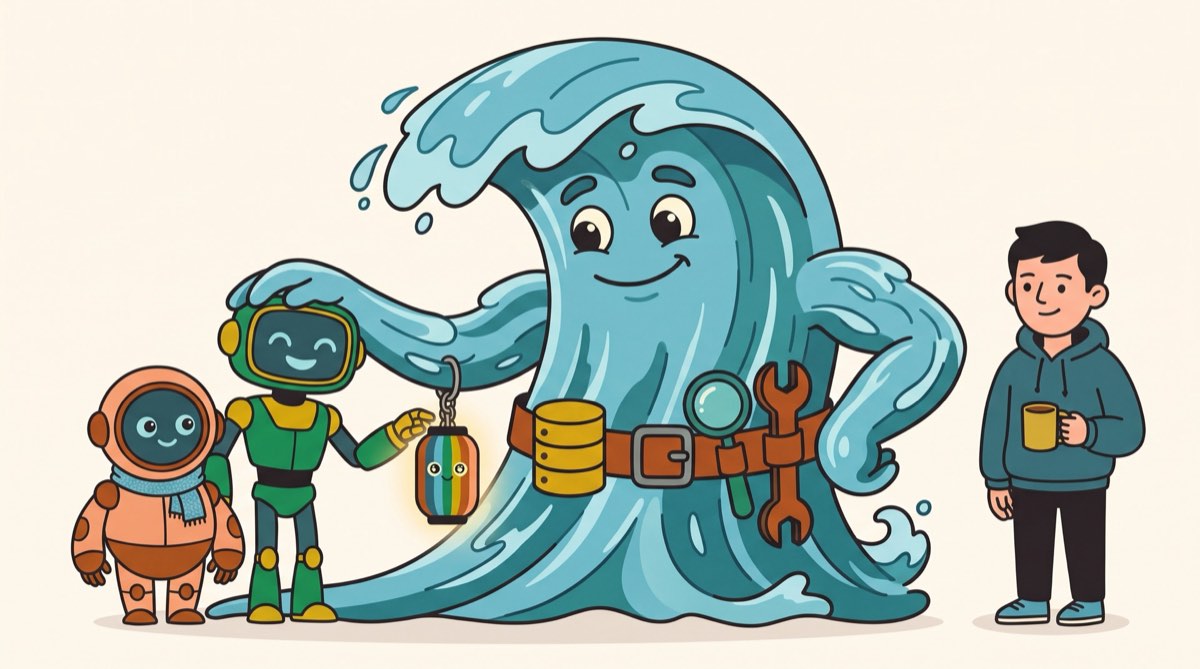
Use Insider next to Tidewave, not instead of it. Tidewave evaluates code and queries the database inside the node. Insider records what happened while requests ran, and observes from outside the request path. In our trials, Tidewave, dev logs and a browser decided most outcomes. Insider supplied the deciding fact in a few: a request-only fact, or a stalled request path.
Status and safety
- Early. Version
0.1.0, the first release. The protocol, APIs and package layout will change. - Dev, test and ci only. The node's own environment decides, never the caller. Live observation is denied in staging and production until separate human decisions allow it: see the production boundary.
- Your data. Development and test default to the
richprofile, which assumes your development data holds no real personal data. If it does, setconfig :insider, :live_disclosure, :strict. - A guest in your node. Sessions are leased, bounded and cleaned up, and
stopreturns a cleanup receipt you can check. - OTP 28 or later for call traces and OpenTelemetry capture. Elixir 1.17/OTP 27 is the floor for the rest.
Documentation
The documentation index tells you, or your agent, which section to read for which task. Start with Getting started or the cheat sheet. Contributors start with Development.
Community
CONTRIBUTING.md: setup, the quality gates, tests-first rules, and commit and pull request conventions. Contributors and coding agents also followAGENTS.md.CODE_OF_CONDUCT.md: the Contributor Covenant 2.1.SECURITY.md: supported versions, private vulnerability reporting, and what Insider's security promises cover.
License
Insider is licensed under the MIT License. See LICENSE. The
text under LICENSES/ covers only the third-party code listed in
THIRD_PARTY_NOTICES.md.